THIS SITE IS PRESENTED & MAINTAINED BY SEQUIM DOG PARK PALS
Little moments from the dog park that might make you stop, think… and say, “Huh. I never thought of it that way.”

Smart Park...at the Dog Park
Smart Park… at the Dog Park
You and your dog have had a lovely time at the park. You head out the gate, walk across the grass toward the parking lot, and there it is—your trusty vehicle, waiting to take you home.
There is just one small problem.
You can’t get your dog into it.
While you were playing at the park, two other vehicles arrived and parked cozily beside yours. Very cozily. Human-scooch-through-the-door cozily.
And perhaps you can scooch through the door.
Your 80-pound dog cannot.
Not every large dog enters an SUV through the back.
Or maybe it's a car with no hatchback.
Some dogs have been trained to jump through a side door. And doing that safely requires the door to open fully. Not every person can lift a large dog into a vehicle, either. Nor does everyone carry a ramp or set of steps for a dog who normally hops quite happily into the back seat.
So, there you stand. Dog: ready to go home. Vehicle: right there. Door: technically opens.
Useful opening: approximately seven inches.
Meanwhile, the people who parked beside you may be enjoying a leisurely stroll around Carrie Blake Park. Perhaps they've gone for a picnic. Perhaps they have begun an entirely new life somewhere beyond the duck pond.
You don't know.
You only know that you and your dog aren't going anywhere until somebody comes back. 😂
It actually happens more than you think.
Here's the funny thing: our parking area generally has plenty of room. This isn't downtown Seattle at lunchtime. There's rarely a prize for fitting three vehicles into space that could comfortably accommodate four doors opening.
So perhaps, when we pull into the dog park, there's one small thing worth noticing before we turn off the engine:
Could the person beside me open their door all the way?
Not because every dog needs that much room.
Because somebody's does.
Sometimes being considerate at the dog park begins before we ever reach the gate. 🐾

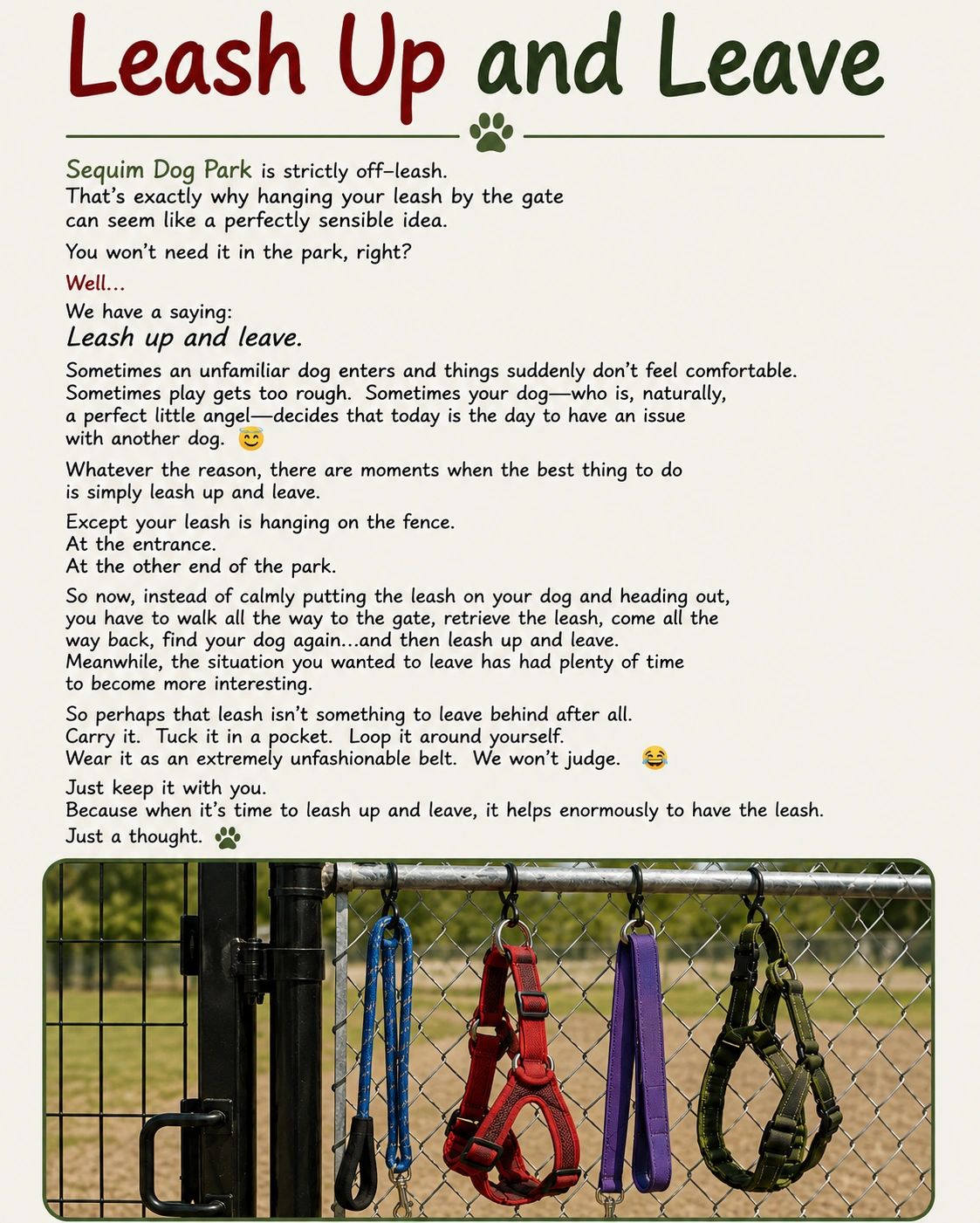
Leash Up and Leave
Sequim Dog Park is strictly off-leash.
That's exactly why hanging your leash by the gate can seem like a perfectly sensible idea.
You won't need it in the park, right?
Well...
We have a saying:
Leash up and leave.
Sometimes an unfamiliar dog enters and things suddenly don't feel comfortable.
Sometimes play gets too rough. Sometimes your dog—who is, naturally, a perfect little angel-decides that today is the day to have an issue with another dog.
Whatever the reason, there are moments when the best thing to do is simply leash up and leave.
Except your leash is hanging on the fence.
At the entrance.
At the other end of the park.
So now, instead of calmly putting the leash on your dog and heading out, you have to walk all the way to the gate, retrieve the leash, come all the way back, find your dog again...and then leash up and leave.
Meanwhile, the situation you wanted to leave has had plenty of time to become more interesting.
So perhaps that leash isn't something to leave behind after all.
Carry it. Tuck it in a pocket. Loop it around yourself.
Wear it as an extremely unfashionable belt. We won't judge. 😉
Just keep it with you.
Because when it's time to leash up and leave, it helps enormously to have the leash.
Just a thought. 🐾
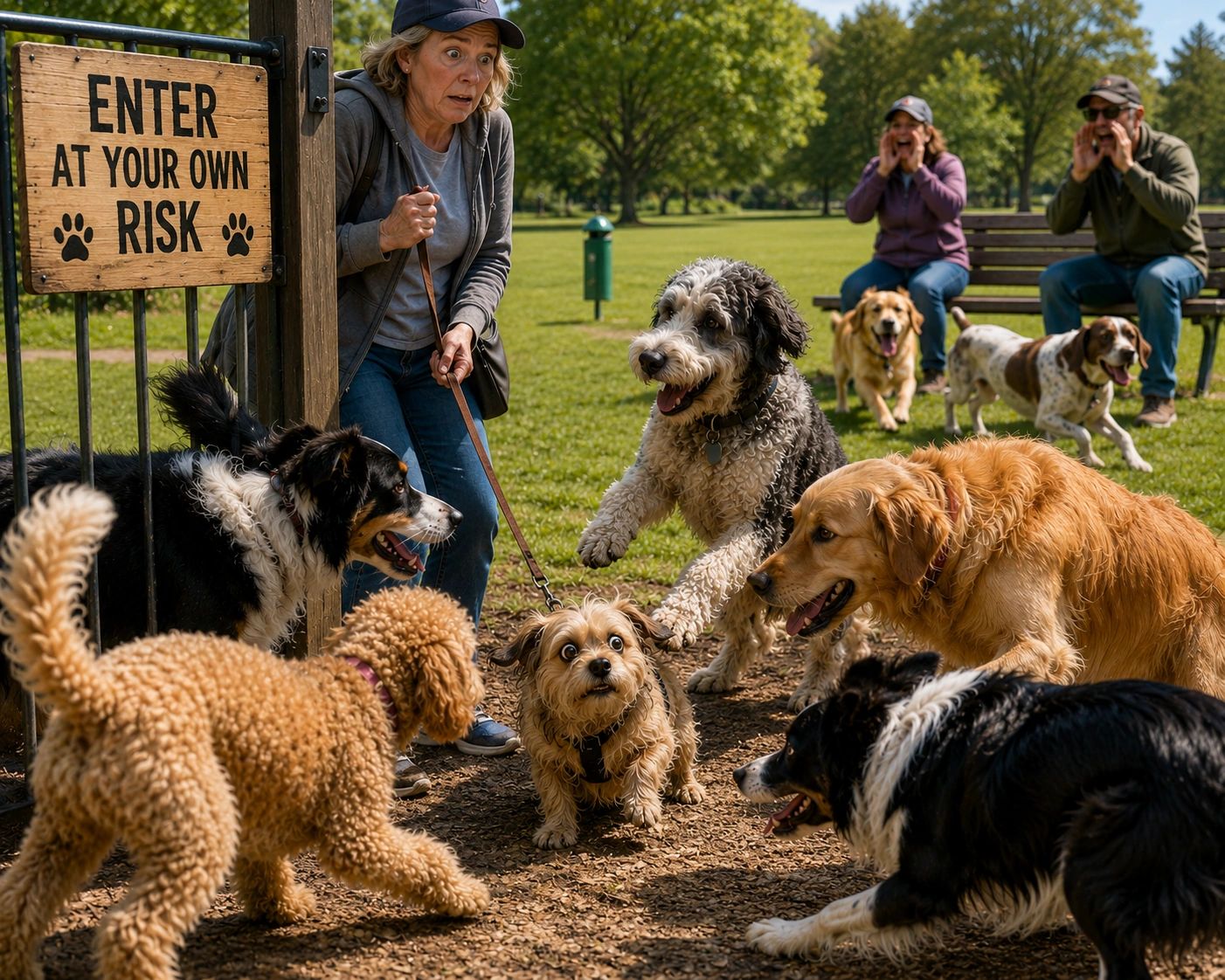
Enter at Your Own RIsk 😉
Make Way at the Gate
You and your dog arrive at the park.
Perhaps it's your first visit. Maybe your dog's first visit. Maybe you've been here a hundred times.
You open the gate.
And suddenly—
WELCOME!!!
Dogs come racing over to investigate the new arrivals.
Everybody is excited.
Especially the dogs.
Your dog is now surrounded by lots of unfamiliar noses, unfamiliar bodies, and considerably more enthusiasm than anyone requested. One dog is jumping on your dog. Another is jumping on you. Everybody would apparently like to become acquainted immediately.
There is a sign on the gate that says:
ENTER AT YOUR OWN RISK.
To be clear, this is not what we meant. 😂
Meanwhile, across the park:
“Rover! Come!”
Rover does not come.
“SPOT! COME HERE!”
Spot has other plans.
So, the humans employ the time-honored strategy used when someone doesn't respond to something we've said:
Say exactly the same thing, only MUCH LOUDER.
“ROVER!!!”
“SPOT!!!”
Now the dogs at the gate are even more excited.
And your little dog—who was already trying to figure out why four strangers descended upon them the instant they entered the park—is learning something else about this interesting new place:
Apparently people yell here.
A lot.
It’s scary.
I must have done something wrong.
So, let's try a little Dog Park Tails multiple choice.
Your dog is part of the enthusiastic welcoming committee at the gate and isn't responding when you call. Do you:
A. Stay where you are. The person coming through the gate will figure something out.
B. Keep calling, progressively louder, until either your dog comes or someone in Victoria hears you.
C. Get up, walk to the gate, collect your dog, and give the newcomers enough room to enter and settle before the introductions begin.
Hmm.
Now imagine you're the person standing inside that gate with the overwhelmed little dog.
Which would you choose?
Just a thought. 🐾
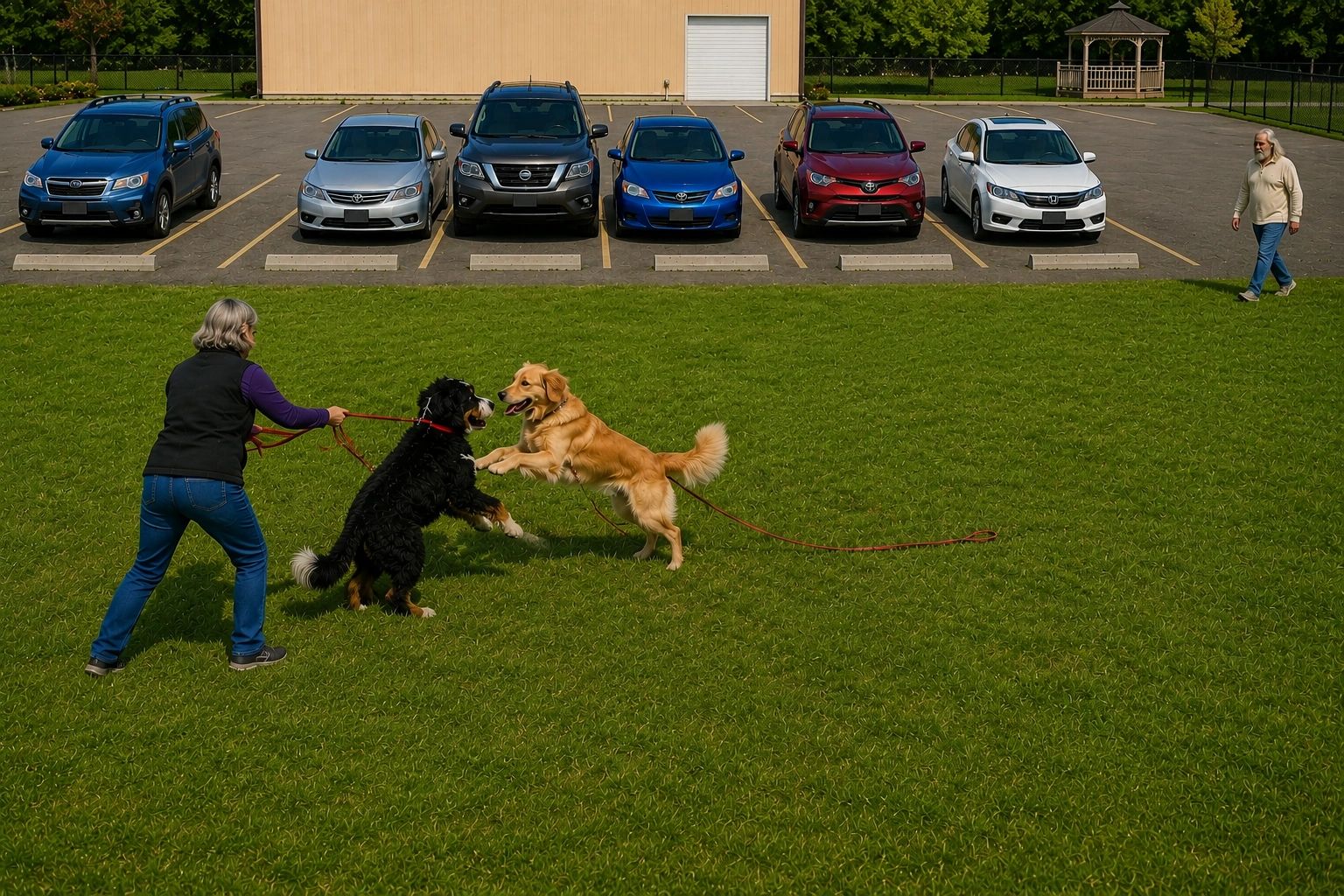
They Just Want To Play... ...but the lawn is not the dog park
A person leaves Sequim Dog Park with their dog on leash and begins walking across the lawn toward the parking lot.
Why is the dog on leash?
Well, there's an easy answer to that.
Because outside the fenced dog park, the dog is required to be on leash.
But there may be another reason it is particularly important that other dogs don't come bounding over to say hello.
The dog may be revving down after an exciting time running and playing in the off-leash dog park, learning that leaving the dog park means shifting gears:
Playtime is over. Time to walk calmly.
The dog could be old and arthritic.
Recovering from surgery.
A puppy learning to walk politely on leash.
Frightened by unfamiliar dogs.
Or extremely reactive when approached by an unleashed dog.
(See our separate piece on Dog Leash Psychology 101.)
You don't know.
And you don't need to know.
Now another person arrives.
They get out of their car with a large, enthusiastic dog – let’s say a lovely Golden Retriever, for example. The dog has a leash attached—but instead of holding it, the person lets the leash drag along behind the dog.
The Golden bounds across the lawn, reaches the leashed dog and begins jumping around and on the dog, eager to play.
FREEZE FRAME.
Before we go any further, let's establish something.
The lawn between the parking lot and Sequim Dog Park is not part of the off-leash dog park.
Under Sequim Municipal Code 12.24.010(I), domesticated animals are prohibited from running at large in a public park or playground. The exception is dogs using the City's designated off-leash dog park.
That's the fenced area.
The lawn isn't the dog park.
The parking lot isn't the dog park.
Almost at the dog park isn't the dog park.
Violation is a misdemeanor offense carrying a potential fine of up to $500.
So:
"But my dog is friendly."
"I do this all the time."
"Nothing has ever happened."
"He just wants to play."
"We're practically at the gate."
None of those things changes the law.
You don't have to agree with it.
You don't have to like it.
But you do have to hold the leash.
Okay.
UNFREEZE FRAME.
The Golden Retriever is still jumping on the leashed dog.
The person holding the leashed dog says politely:
"Excuse me. This isn't an off-leash area. Please get your dog."
The Golden Retriever's person continues moseying across the lawn.
"Oh, it's no big deal. They just want to play."
"Please leash your dog. This isn't an off-leash area."
The leashed dog is becoming increasingly excited.
Or frightened.
Or uncomfortable.
Or reactive.
Remember—we don't know.
The Golden's person continues slowly toward the dogs and says, "You need to calm down."
"I am calm. Please get your dog."
"You need to relax."
FREEZE FRAME.
Let's talk about the phrase:
"They just want to play."
How do you know?
You know your dog wants to play.
You know absolutely nothing about the other dog.
More importantly, the other dog's person gets to decide whether their dog interacts with yours.
Maybe that person has just spent twenty minutes teaching an adolescent dog how to leave an exciting environment calmly.
Maybe the dog is elderly.
Maybe the dog is terrified of Golden Retrievers.
Maybe the dog will bite yours.
You don't know.
And:
"Please get your dog" is enough.
The person with the leashed dog does not owe you their dog's medical, behavioral or training history before you control yours.
But wait.
There's another individual in this scene whose safety we haven't discussed.
The human holding the leash.
You know nothing about that person's physical capabilities either.
They may be perfectly capable of walking one calm dog across a lawn and completely unable to safely manage two exuberant dogs suddenly jumping, circling, pulling and tangling around them.
They may be elderly.
They may have balance problems.
They may have an invisible disability.
They may be recovering from surgery or injury.
They may simply not have the strength or stability to handle the additional activity your dog has unexpectedly introduced.
Walking one leashed dog is one thing.
Being involuntarily appointed traffic cop for two exuberant dogs is another.
And if that person falls?
"Don't worry, my dog is friendly" suddenly isn't terribly reassuring.
UNFREEZE FRAME.
Now let's return to that leash dragging behind the Golden Retriever.
Some people seem to believe this creates a convenient loophole:
"Oh! I dropped the leash."
Why would we even mention that?
Because dog owners have actually told us they do precisely that.
A leash dragging behind a freely running dog does not make the dog controlled.
There is no human on the other end.
And ironically, the dragging leash can make the situation more dangerous.
A running dog can circle a person and wrap that leash around their legs.
The two dogs' leashes can become tangled.
The trailing leash can snag suddenly.
Someone can fall.
Serious injuries can result.
It has happened.
And remember: there are cameras in this area.
A leash visibly trailing behind a dog running freely across the lawn may tell a rather different story from:
"Oops. I just dropped it."
There's another dog whose safety we haven't discussed either.
The unleashed dog.
"My dog never runs away."
Maybe not.
But has never happened and can never happen are two very different things.
Parks contain the unexpected.
A sudden noise.
Wildlife.
Another dog behaving strangely.
Something frightening.
A dog who has calmly made that walk 200 times can encounter something entirely different on trip 201 and bolt.
A leash isn't merely restraint.
Sometimes it's a safety line.
If you choose to disregard the leash law and take that chance with your own dog's safety, that's one decision.
What you don't get to do is make another decision for somebody else's dog—or somebody else's body.
And then there is the matter nobody particularly wants to think about:
What happens when somebody gets hurt?
If your unleashed dog runs over to a properly leashed dog and injures that dog, you may find yourself dealing with considerably more than a leash-law violation.
There may be veterinary bills.
There may be damages.
There may be civil liability.
It has happened.
And what if your unleashed dog charges a properly leashed dog and your dog is injured?
Don't automatically assume the other dog's owner will be paying your veterinary bills.
Your dog was loose where the law required control. The other person was complying with the law. Those facts can matter considerably when responsibility for what happened is determined.
In other words:
"They just want to play" can become a very expensive sentence.
Okay.
Back to our story.
UNFREEZE FRAME.
The Golden Retriever is still loose.
The leashed dog's person has politely asked more than once for the dog to be retrieved.
Instead, the Golden Retriever's person has explained that the situation is no big deal and has now appointed himself Director of the Other Person's Emotional Regulation.
"You need to calm down."
"Please get your dog."
"You need to relax."
FREEZE FRAME.
You're holding the leash.
Your dog is properly leashed.
Someone else's unleashed dog has run across a leash-required area and is jumping on yours.
You've politely asked the owner more than once to retrieve their dog.
The owner has declined to do so, gnored your polite requests and is now critiquing your escalated emotional response to the problem they created.
What do you do?
A. Apologize for having your legally leashed dog in the way of their illegally unleashed dog.
B. Calm down immediately. After all, the person ignoring the leash law has just informed you that this would be appropriate.
C. Let the dogs continue playing because a complete stranger has determined that your dog wants to play.
D. Repeat your request somewhat more emphatically—and perhaps discover that your vocabulary has unexpectedly expanded.
E. Document the incident and contact Animal Control. There are cameras in the area.
Hmm.
Which would you choose?
We aren't going to tell you which option the person in our story selected.
😇
Okay.
Let's just say D became considerably less polite.
And that's really the point.
The leash law isn't there because every unleashed dog is dangerous.
The Golden Retriever in our story may be an absolutely lovely dog.
He saw another dog.
He wanted to play.
He's a dog.
The human is responsible for knowing where that play is permitted.
And fortunately, if you're standing on this particular lawn, there's a rather wonderful place nearby where your dog can legally run, chase, wrestle, sniff, romp and conduct whatever mysterious canine business seems necessary that morning.
We know exactly where it is.
We founded it and have spent a couple of decades helping maintain it.
It's inside the fence.
Outside the fence:
Hold the leash.
It's only a short walk.
Just a thought. 🐾
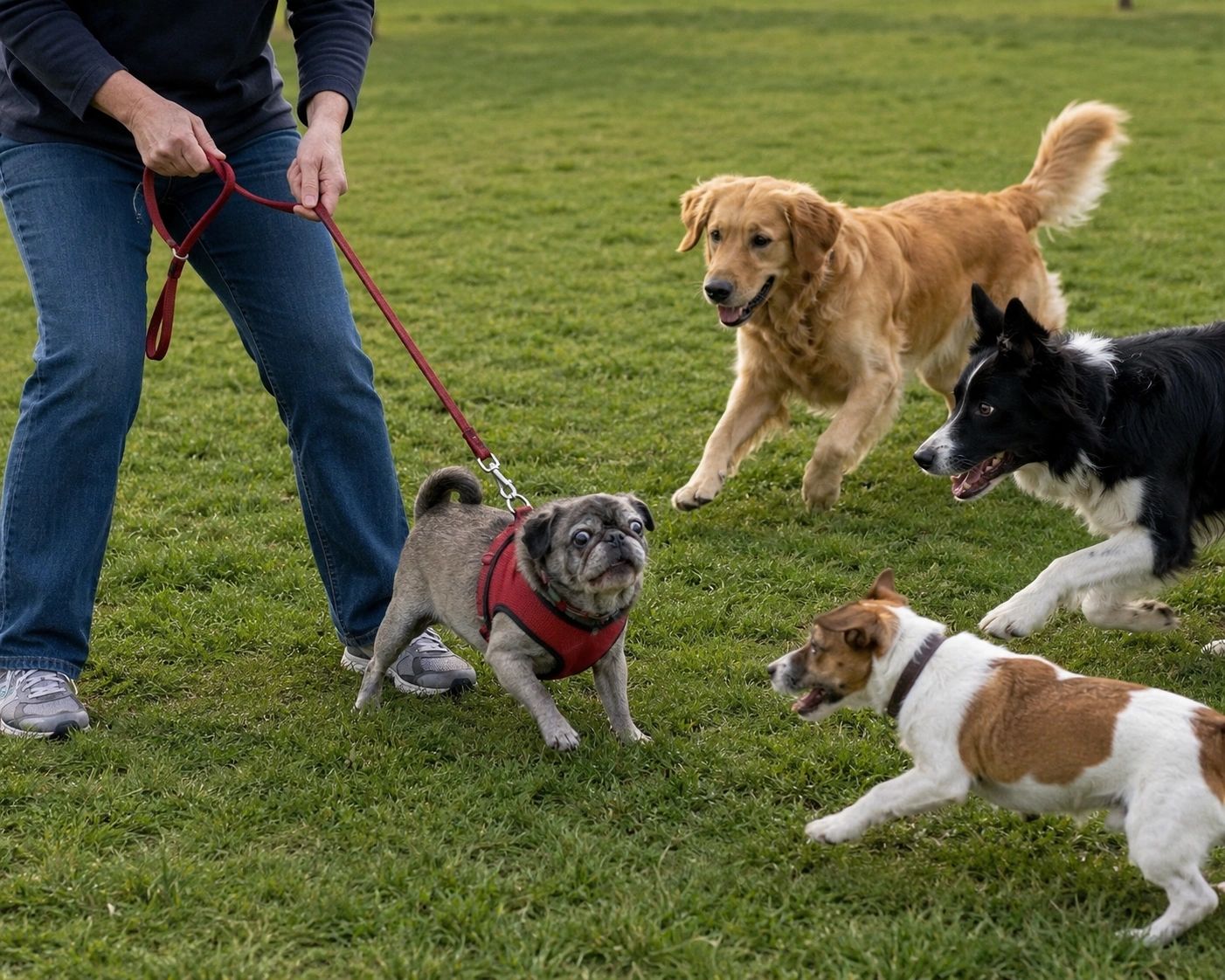
Leash Psychology 10 1 at Sequim Dog Park. 🐾 It All Depends on What Side of the Fence You're On. 🐶
Wait.
Didn't we just tell you to keep your dog on leash outside Sequim Dog Park?
We certainly did.
Now we're going to tell you to take the leash off before entering the off-leash area.
Contradictory?
Not at all.
The gate changes everything.
Outside the fenced dog park, your dog is in an on-leash environment.
Inside the fenced dog park, your dog is entering an off-leash environment where dogs are expected to move freely, interact with one another, approach, retreat, circle, sniff, play—and, when necessary, move away.
That's why we have the double-gated entry area.
Enter the first gate with your dog on leash.
Close the gate behind you.
Remove the leash.
Then enter the off-leash area.
Simple.
But why does it matter?
A Leashed Dog Has Fewer Choices
Dogs communicate with much more than barking and wagging tails.
They communicate with movement.
A dog can approach another dog.
Slow down.
Turn sideways.
Circle.
Stop.
Back away.
Increase distance.
Leave.
Those choices matter.
Research into canine behavior and frustration supports something dog professionals have observed for years: physical restraint can change a dog's response to a situation because it limits the dog's ability to control distance and movement.
Now imagine entering an off-leash dog park with your dog still attached to a leash.
Several curious dogs run over to investigate the newcomer.
Those dogs are free to move.
Your dog isn't.
If your dog wants more distance, the leash may prevent it.
If your dog wants to approach, the leash may prevent that too.
Either situation can increase frustration, fear, conflict or arousal.
And then something else often happens.
The person holding the leash becomes concerned because several dogs are surrounding their dog.
So they shorten the leash.
Now the dog has even less freedom of movement, and physical tension has been added to an already stimulating situation.
What began as an attempt to make the dog feel safer may actually make the introduction more difficult.
“But My Dog Is New to the Dog Park”
We hear this one frequently:
"My dog isn't used to the dog park yet. I want to keep him on leash until he gets comfortable."
It sounds perfectly reasonable.
But think about the situation from the dog's perspective.
Your dog is entering a completely unfamiliar social environment.
New place.
New smells.
New dogs.
And perhaps several of those dogs are very interested in meeting the newcomer.
This is precisely when your dog may benefit from being able to control distance.
Keeping the leash attached doesn't necessarily provide reassurance.
It may remove choices.
A nervous dog who wants to move away can't.
A social dog who wants to greet another dog may become frustrated because he can't.
Two completely different emotional states.
Same problem:
The leash restricts the dog's options.
If your dog isn't ready to safely enter an off-leash environment without being physically tethered to you, that's okay.
It may simply mean your dog isn't ready for the dog park yet.
There's no shame in that.
Build confidence.
Work on recall.
Let your dog observe other dogs from a comfortable distance.
Come at a quieter time.
Give your dog whatever preparation they need.
The goal isn't to get through the gate as quickly as possible.
The goal is to make the experience a good one.
“Fine. I'll Just Let the Leash Drag.”
Please don't.
Some people tell us they leave a leash—or even a long line—attached and let it trail behind the dog because:
"It's easier to catch my dog that way."
Unfortunately, now we've exchanged one safety problem for another.
A leash dragging behind a running dog can become a trip line.
It can wrap around another dog's legs.
It can tangle with another dog's leash.
It can snag on equipment.
It can wrap around the legs of a person standing perfectly still while dogs race around them.
And that person can fall.
Falls can cause serious, even life-changing injuries.
It has happened.
That's not theoretical.
A leash trailing behind a running dog has no business moving through a group of dogs and people.
If you don't believe you can retrieve your dog without leaving a long line attached, that's another sign that an off-leash dog park may not yet be the right environment for your dog.
So How Do I Get My Dog Out?
Ah.
Now we come to the dog who hears:
"Time to go!"
and responds:
Thank you for the information. I have elected to remain. 😏
Ideally, you call your dog and your dog follows you into the double-gated area, where you attach the leash before leaving.
But dogs occasionally have opinions.
If you need to leash your dog inside the dog park in order to leave, that's perfectly appropriate.
We call it:
Leash Up and Leave.
Notice the last two words.
And leave.
Once you've put the leash on, head for the exit.
It doesn't mean leash up and then stop for another fifteen-minute conversation.
It doesn't mean leash up, finish your coffee and visit with someone who just arrived.
It means:
Leash up. Head for the gate. Leave.
That brief transition is very different from keeping a dog restrained while remaining in an off-leash social environment.
And please take your leash with you while you're in the park rather than leaving it by the entrance.
Why?
We've already written that story.
See “Leash Up and Leave.”
It's About the Environment
None of this means leashes are bad.
Quite the opposite.
Outside the dog park, a leash protects your dog, protects other dogs, protects people—and is required by City code.
But inside an off-leash dog park, the environment is different.
Dogs need the freedom to use normal movement and distance when interacting with one another.
A held leash can interfere with that.
A dragging leash can become a physical hazard.
And a nervous dog isn't necessarily made safer by being the only restrained dog in a group of freely moving dogs.
So remember what that double-gated area is for.
Outside the fence: leash on.
Enter the first gate. Close it behind you. Leash off.
Inside the park: take the leash with you.
Ready to go: head for the gate.
And if necessary:
Leash Up and Leave.
The gate changes everything.
Just a thought. 🐾